Crawl Space Moisture Control in Franklin, TN is humidity control for homeowners whose crawl stays damp even when the yard looks dry: clammy floors, sweating ducts, a musty hatch, or insulation that has fallen onto the soil. Franklin Crawl Space separates the sources—clay, grading, groundwater, HVAC condensate, and outdoor air—then limits soil vapor and sets a dehumidifier to a relative-humidity target the crawl can hold through a Middle Tennessee summer.
What humidity control involves in a Franklin crawl space
Humidity control under a Franklin house is a sequence, not a single machine. We identify the water—storm drainage, groundwater at the low side of the foundation, a plumbing leak, HVAC condensate, or vapor leaving the soil—then stop the sources that can be stopped. Vapor control is the liner: a sealed ground cover with edges turned up and seams closed, so bare clay stops evaporating into the joists. Air control is sealing leaking ducts and piping condensate out of the crawl. The dehumidifier is the last layer. It holds relative humidity in a tightened space. It does not pump a pond out from under the house.
The operating target on the written scope is about 50 percent relative humidity, and a sustained reading above 60 percent means a source is still winning. Paper, dust, and wood stay supportive of surface mold when humidity sits high for days, even with no standing water. The dehumidifier is sized to crawl volume, how much air still leaks in, and the summer moisture load—not to the number of bedrooms upstairs. It gets a permanent drain. If the honest fix is to close the vents and the walls, that scope is crawl space encapsulation, estimated under that name.
Signs the crawl space is too humid
A Franklin crawl is too humid when musty air shows up at the registers, hardwood cups, the first floor feels clammy, or the hatch smells wet after a dry week. Underneath, the matching signs are ducts sweating in summer, rust on metal supports, insulation on the dirt, water stains on masonry, and a vapor barrier that is wet on top or missing. A meter says the same thing: relative humidity that stays elevated, and wood that reads damp where it has been sitting in that air. Condensation on a supply trunk in July shows up from Cool Springs to Fairview. It is a moisture problem.
Standing water, a sump that never catches up, or a mud line on the liner means liquid water, which a dehumidifier will not remove. If that water is from a burst or leaking pipe, a plumber has to stop the leak before we dry the crawl; we do not repair supply lines, and a Nashville house with that leak needs emergency plumbing in Nashville first. Spotting on joists means the humidity has already fed growth, and the cleaning scope is crawl space mold remediation. Batts on the ground are not insulating anything and are wicking soil moisture; they come out under crawl space insulation rather than being stapled back up. The estimate separates those scopes so humidity control is not a vague label for every wet-crawl task.
Why Franklin and Middle Tennessee crawl spaces run humid
Franklin and the rest of Middle Tennessee run humid because the climate is humid subtropical and most of these crawls were vented to it. Summer air in this basin often holds enough moisture that its dew point sits above the temperature of cool supply ducts and shaded joists, so water condenses on those surfaces. Humidity stays high overnight as well. A vent that was supposed to let the crawl breathe pulls that air in and gives it a cool surface to wet. Newer subdivisions and older in-town houses share that outdoor air. The era of the house changes the framing. It does not change the dew point.
Soil is the second source. Williamson County clay holds storm water and keeps releasing vapor after the lawn looks dry. Hillside lots in Westhaven and Berry Farms move water toward one foundation wall. Ground near the Harpeth can stay wetter than a ridge lot nearby. Many 1990s and 2000s houses put the air handler in the crawl, so a clogged condensate line, a secondary pan that overflows, or an unsealed return is a third source. Humidity control treats those as different inputs. A box fan pointed at an open vent does not.
What affects the cost of humidity control
Humidity-control cost in Franklin depends on which sources are active and what it takes to reach them. Re-piping a condensate line is a different job from a crawl with standing water, a missing liner, and ducts that sweat across the footprint. Clearance, hatch access, and how much debris or old plastic is in the way change the labor before any drying equipment is set. A dehumidifier that can drain by gravity is a simpler install than one that needs a pump and a route to daylight. We price what is in the crawl. There is no flat moisture package.
The estimate also changes if vapor control means repairing a sound liner or replacing a shredded one, if a sump is actually warranted, and if the vents have to be closed before a dehumidifier can hold a target. Closing the whole envelope is Crawl Space Encapsulation and is priced as that service. Wood that is already decayed is Crawl Space Repair and is not folded into a drying number to make one line look complete. Those names are on the written estimate because they are different work.
Repair, replace, or a DIY dehumidifier
Repair the moisture source you can point at: a split condensate line, an open duct joint, a downspout dumping at the foundation, a sump with nowhere to discharge, a liner seam that has pulled apart. Replace the vapor barrier when the plastic is thin, torn across the bays, or buried under wet insulation. Patching that sheet does not restore vapor control. Replace a dehumidifier that is undersized for the volume, iced over, or installed with no drain. A second bucket machine next to a dead unit is not a system.
A portable dehumidifier in an open, vented Franklin crawl is usually outmatched. It fights outdoor air all summer, fills a bucket that overflows onto the soil, and still leaves the joists in the humidity range where mold can continue. That setup also skips the vapor-control layer and the duct leaks that keep the load high. The professional order is source first, sealed vapor control second, then a drained dehumidifier set near 50 percent relative humidity, with anything that stays above 60 percent treated as a cause that is still open. On most vented crawls in this county, placing the unit and leaving the vents alone is not the job.
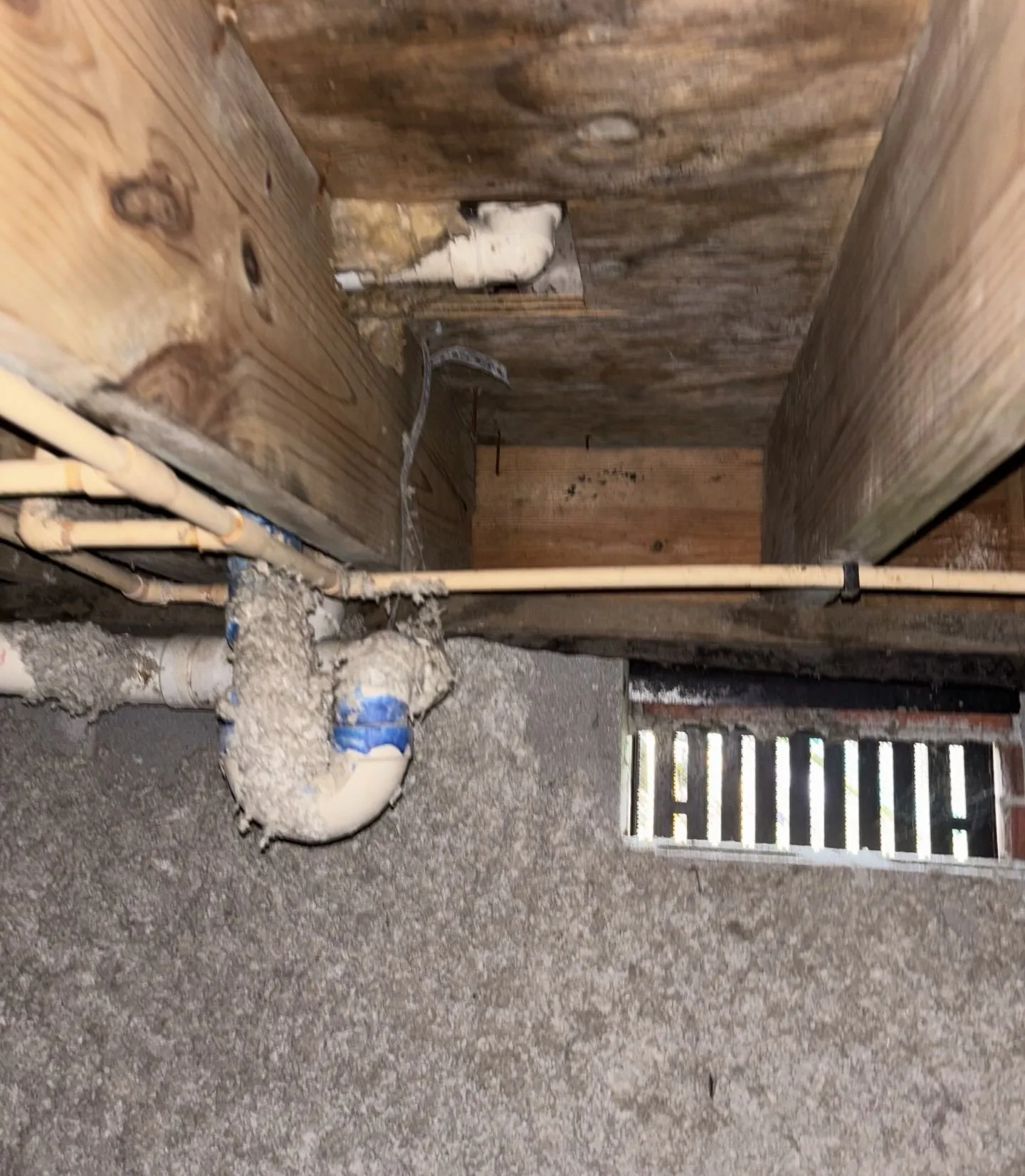
Photo from a humid crawl space
This photo is from a real crawl space job our crew has worked.
An open foundation vent next to drain lines, with staining on the subfloor above. Photo from a Spring Hill area job.
FAQ
Humidity control questions
What relative humidity should a Franklin crawl space hold?
On a sealed or tightened crawl we set the dehumidifier near 50 percent relative humidity and treat a reading that stays above 60 percent as a problem, not as normal summer behavior. Below that upper line, joists and paper-faced insulation are less likely to stay damp enough to support mold. The number on the dial does not count if the drain is a bucket or the vents are still open. We check the target with a meter, not from the sticker on the machine.
Can a dehumidifier alone fix a wet Franklin crawl space?
No, not when water is standing, a pipe or condensate line is leaking, or the soil is bare. A dehumidifier holds humidity in a space that is already drained and covered. Pointed at an open vented crawl, it runs against outdoor air and often overflows onto the dirt. Franklin Crawl Space uses the unit as the last layer, after vapor control and any liquid-water repair.
Do you install sump pumps in Franklin crawl spaces?
We specify a sump when groundwater or collected drainage has a place to discharge and a pump is the straightforward way to get it there. A hillside Westhaven lot and a flatter ranch do not get the same answer. The estimate says pump or no pump after we see water marks and the grade. A sump under a torn liner, with vents still open, is not humidity control by itself.
Will humidity control help musty air upstairs?
It helps when the crawl is the source and leaks in the floor or the HVAC return are pulling that air into the living space. Drying the crawl removes that load. It does not treat a smell from a bath fan, a wet wall, or growth already established on the joists. Visible mold is a remediation scope, separate from the dehumidifier.
When is humidity control enough without full encapsulation?
It is enough when the water source is specific, the wood is sound, and a sealed vapor barrier plus a drained dehumidifier can hold the target without closing every vent. That happens, and we will write the smaller scope when the readings support it. If summer air still enters through foundation vents, or the walls are part of the wet assembly, encapsulation is the system that can hold the target.